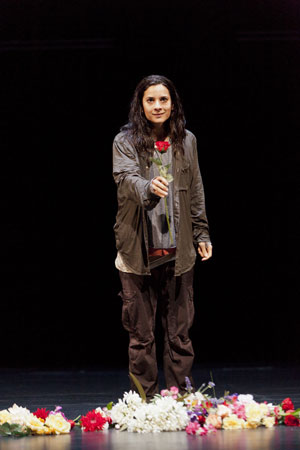
 Left – Andrea Demetriades. Cover – Andrea Demetriades and Marco Chiappi. Photos – Brett Boardman
In the tradition of the grand theatre's of the world, the curtain has been the primary trigger of a "reveal" to an audience. The curtain has hidden the scuffling and shuffling about of actors and assistant/stage managers back stage, out of sight. Then a moment of pause before the curtain rises, revealing a new world or reality to delight the anticipating eye.
At the time of the premiere of George Bernard Shaw's Pygmalion, there was divide between a tendency/trend towards a naturalistic setting (set up by Ibsen) and then of course, a revolt to the more stylized (by Adolphe Appia and Edward Gordon Craig). For those who enjoy the guilt frame of an embellished proscenium arch theatre – Sydney Theatre Company's Pygmalion will leave you a little dumb-founded. This is not a production encased in a richly detailed set. This is not about visual impact, it is a production which puts the story, more over character, firmly in the centre of its sight.
Taking his inspiration from the Greek myth of Pygmalion, best found in Ovid's Metamorphosis, wherein a sculptor falls in love with his own creation, George Bernard Shaw's play is billed as a "Romance in five acts." However this is more than a weak-wristed romance of traditional role-play. This is a beautifully crafted text, which has much to say not only about the value of language, status, education and the joys and sorrows of work, but true love.
Rain drenched and desperate, Eliza Doolittle (Andrea Demetriades) struggles onto stage, coercing and defending and offering in equal measure. She is outside the theatre, struggling to sell an armful of flowers to patrons eager to find a cab for their journey home. Before long, a gentleman with a notebook, Henry Higgins (Marco Chiappi) wages with Colonel Pickering (Kim Gyngell) that he will be able to revolutionize Eliza's uncouth diction and savage manners into a lady, into that of a Duchess at a ball.
The next day we find Eliza fronting up to Wimpole Street with the aspiration of elevated elocution in order to become "a lady in a flower shop." Challenge accepted, Pickering and Higgins set to work on Eliza's transformation.
Peter Evan's direction is slick and no-fuss, he focuses on the characters and their wish to propel the story. Dramaturgically, this is not man versus world, (nor society) by man versus himself. Higgins (Marco Chiappi) as the linguistic genius – prone to tantrums and displays of childish arrogance is kept in check by a stern and patient housekeeper, Mrs Spence (Deborah Kennedy) and his mother Mrs Higgins (Wendy Hughes.) The performances are excellent all round with Demetriades convincingly transitioning from urchin to urchin in a lady's clothing to a lady – with great finesse.
On the evening I saw the production, there was no evidence of the audio visual element mentioned in the program – except a rather perplexing introduction and retraction of a white screen after interval. Additionally the end moment saw Higgins chasing Eliza with a hand-held camera. I found the introduction of such technology a little extraneous to the story. For without it, I was able to enjoy the struggle of my own allegiances. I was more interested in dealing with the questions within the play:
What are we left with, once we are transformed? What do we, or can we go back to? What is the plight of the middle and the upper classes. What is freedom? What is our duty to the English Language – it's preservation and it's disintegration? Does Higgins sacrifice himself, and his own (romantic) happiness in order to empower and inspire Eliza to pursue a life greater than fetching a man's slippers? Does Eliza truly feel that the best she can do is marry Freddy? Should we be careful what we wish for? What if our own elevation/improvement was to be our own demise – would we still yearn for it?
Perhaps the audio visual element was to supplement a naked stage? For what it's worth, I did not feel short changed in the slightest about the lack of flash and pomp – I found the performance of the cast to be sufficiently inspiring and intriging. Set Design by Peter Cousins, and costume design by Mel Page, were indicative of place, of status and spoke simply to the story – which is complex and fascinating enough, without having to compete with visual fuss. It's a bold statement to have a bare stage, but an appropriate one for this production, reminding us of how voice and language has its own texture and its own weight, it's own currency. When we hear a voice or how someone uses language we immediately make assumptions about their education, status, worthiness, occupation – we don't need a heightened, elaborate aesthetic to "hear" that message.
Peter Evans' Pygmalion is powerful and challenging. For some it may come in addressing the value of design, for others it may be the portrayal of gender politics/roles, for some the notion that a disintegration of language possibly been seen as an innovation (by the likes of Clara Eynsford Hill) will be depressing. For me, Evan's has created a tight production – metatheatrical, historical, political which lives very much in the present. It asks us to examine our own prejudices about theatre, art, marriage, language, status, money – and none of it is easy, but it is a highly rewarding play.
Sydney Theatre Company presents
Pygmalion
by George Bernard Shaw
Director Peter Evans
Venue: Sydney Theatre
Dates: 4 February – 3 March, 2012
Tickets: $45 – $130
Bookings: www.sydneytheatre.com.au
Sydney Reviews
Pygmalion | Sydney Theatre Company
- Details
- Augusta Supple
Most read Sydney reviews
The Lark | Hey Dowling
Noni Hazlehurst brings Rose and The Lark to colourful and compelling life in this one-woman show.
Pride & Prejudice* (*sort of) | Neil Gooding Productions & Woodward Productions
This rollicking musical take on Jane Austen’s beloved novel is a side-splitting crowd pleaser.
Heartbreak Hotel | EBKM
Heartbreak Hotel invites its audience into an intimate portrait of the universal and isolating experience of heartbreak.
Current | Sydney Dance Company
While Bonachela’s work is, as always, dreamily lovely, for me the highlights were absolutely the three commissioned choreographers: Azzam Mohamed, Jenni Large and Raghav Handa.
The Gospel According to Paul – The Second Coming | Soft Tread Productions
The Gospel According to Paul is meticulously crafted entertainment. It’s uplifting without pulling any punches.
The Gospel According to Paul is meticulously crafted entertainment. It’s uplifting without pulling any punches.

While Bonachela’s work is, as always, dreamily lovely, for me the highlights were absolutely the three commissioned choreographers: Azzam Mohamed, Jenni Large and Raghav Handa.